Live in Production
2025
Small to mid-size law firms (2–20 attorneys) face a structural staffing problem: high inquiry volumes arrive via phone, email, and web form around the clock, but human receptionists are expensive, unavailable after hours, and spend most of their time on repetitive intake tasks — asking the same qualifying questions, manually checking calendar availability, and typing notes.
Every unanswered after-hours message is a potential client calling the next firm. Every hour a paralegal spends on administrative follow-up is a billable hour lost. And every manual booking step is a point of failure — double bookings, missed conflict checks, and forgotten follow-ups.
The firm needed a system that could handle client communications, scheduling, and administrative tasks with the consistency and availability that no human receptionist can match — while integrating directly with Clio, their practice management system.
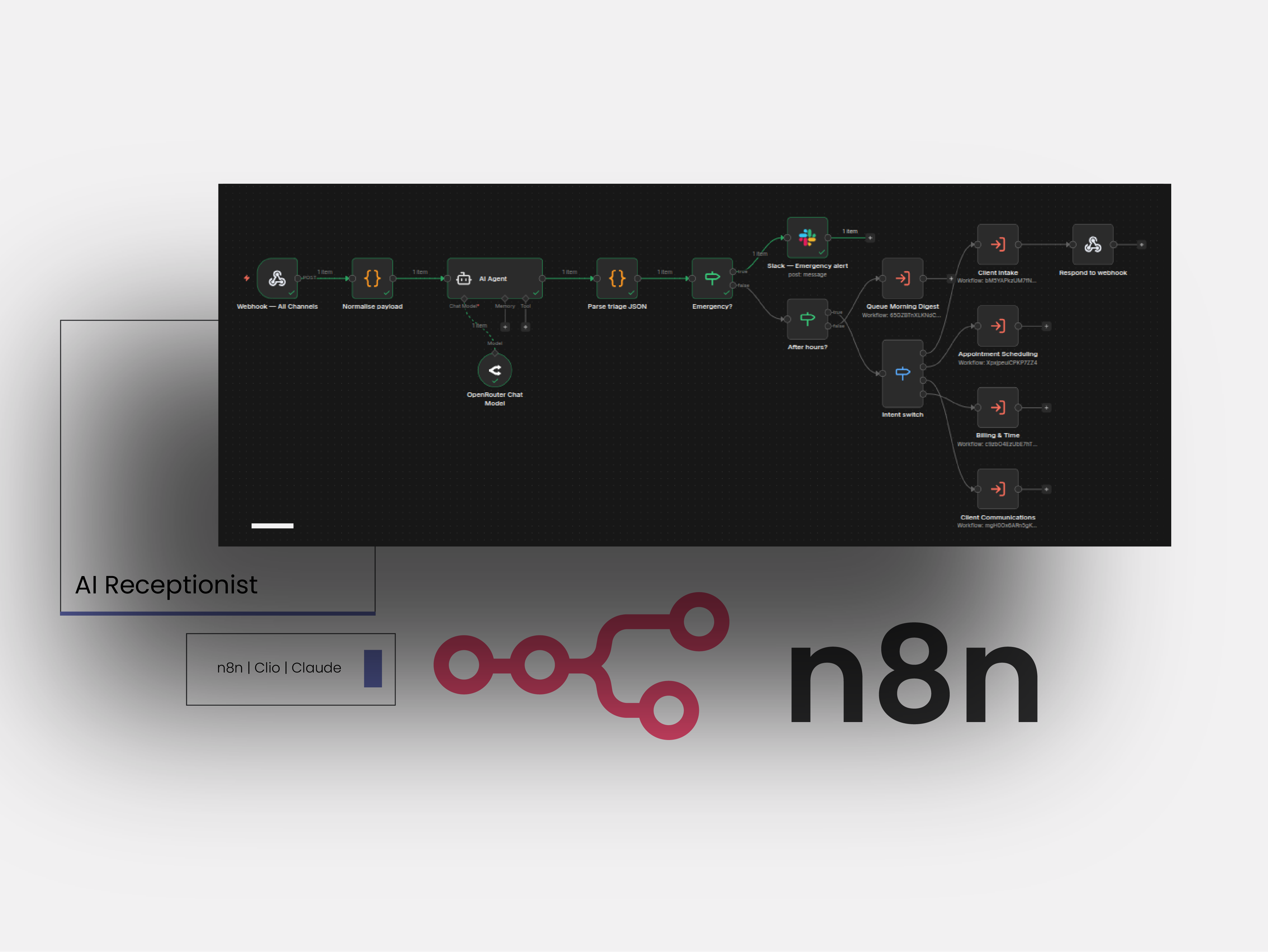
I built a comprehensive 8-workflow automation platform on n8n that handles the full receptionist function. Each workflow owns a discrete responsibility, and Claude Opus handles the AI reasoning that makes the system behave intelligently rather than just mechanically.
Every inbound message — whether from email, web form, or phone — is classified by intent and urgency using Claude Opus. The router determines whether the message is a new enquiry, an existing client communication, a billing question, or a scheduling request, then dispatches it to the correct downstream workflow.
New enquiries trigger an intake workflow that extracts client details and creates a contact and matter directly in Clio, the firm's practice management system. All data captured during qualification flows into Clio without any manual data entry.
The scheduling workflow generates a branded HTML email containing clickable booking buttons. Each button is a GET webhook URL with all appointment data pre-encoded as query parameters — clients confirm a consultation in a single click, with no form to fill out and no reply required.
When a new matter is created, the conflict-check workflow fires two parallel Clio API searches simultaneously — one against contacts, one against existing matters — to surface potential conflicts before the attorney reviews the intake. Results are posted to a Slack channel for attorney review.
For qualified matters, the platform generates engagement letters and client questionnaires automatically, pulling the client's name, matter type, and intake details from Clio. Documents are emailed to the client and stored in their Clio matter.
When an existing client sends a message, Claude Opus drafts a contextually appropriate response based on their matter history in Clio. The draft is sent to the attorney via Slack for one-click approval before delivery.
Invoice requests and payment queries trigger a billing workflow that pulls the client's billing summary from Clio, generates a plain-English payment summary, and emails it with a payment link. The attorney is notified on Slack.
At 8 AM every day, a digest workflow summarises all overnight activity — new enquiries received, consultations booked, conflicts flagged, and documents sent — into a structured Slack message delivered to the attorney before the first client call of the day.